Baked Egg & Kale Bites


We're on our way back home today and I couldn't be more excited to start baking holiday cookies and treats.  I am going to call myself "Intha" for the entire month of December, which is a name I just made up by combining Martha and Ina.  It's a beautiful name, isn't it?  I will most likely name my 4th or 5th or 6th baby Intha.  What's more important, however, is the spirit that Intha represents, which is "holiday food and decor created in an obsessive and perfect way."  Yeah, Intha be crazy.  So look forward to that!

But first, please enjoy this easy (my phone just autocorrected "easy" to "rash" and that made me chuckle) breakfast snack.  It's very simple to throw together and extremely versatile, meaning everything and anything can go into it.  Here's what I did:

To make 6 bites, whisk 6 eggs together in a bowl with a couple tablespoons of milk.  Add one cup of chopped kale, and stir.  Season with salt and pepper.  Spray a muffin tin with baking spray.  Add one slice of pancetta to each cup (optional), and then evenly distribute the eggs.  Bake for 20-30 minutes at 350 degrees.  I put the broiler on for the last few minutes to make them golden brown.

Pacific Merchants Fermentation Crock Giveaway!

Did you read my reviews of books on pickling and fermentation? The techniques are easy to master and the ingredients are not expensive, but there are some tools that are particularly helpful. One would be a fermentation crock.

I was recently contacted by Pacific Merchants about their fermenting and storage crocks. Pacific Merchants is a small, family owned and run company in Los Angeles. They carry unique, beautiful and fun to use products from around the world. There are several reasons why their crocks are so good for fermentation. But they can explain that better than I can:
The 5 liter crock is tall but actually has a fairly small footprint. It fits nicely in a corner of my pantry. My cool, dark pantry should maintain the ideal temperature for fermenting vegetables, about 65-72 degrees. Once I have fermented the vegetables to my liking (I'll start tasting about a week after fermenting) I can water bath can them or store them in the refrigerator, which will maintain their live active cultures.

This handsome looking crock comes with the stone weights, so while the 5 liters might seem large, I won't actually be filling up the entire thing.

Pacific Merchants is offering one lucky Cooking with Amy reader a 5 liter fermentation crock worth $117! 
In order to be considered to win, please leave a comment telling me what you would like to ferment in the crock, some suggestions include sauerkraut, kimchi, pickles, bread starter or kombucha. You must have a US mailing address to win, and you must include your email in the appropriate field when you leave a comment (your email will only be visible to me). One entry per person. I will choose a winner at random, this Friday, December 5, 2014.


Disclaimer: My thanks to Pacific Merchants for providing me and one of my readers with a fermentation crock. I was not monetarily compensated for this or any other post. 

Root Vegetable Mash


Hello friends!  How is everyone doing on this back-to-reality Monday?  I'm feeling a little full, and a little stressed that it's December 1st and there are THREE MORE WEEKS UNTIL CHRISTMAS.  I plan on spending most of this cyber day one-clicking presents and typing in promotional codes, and maybe by nightfall (who says that) I'll feel better.  

The truth is, we've been away from home for awhile and I always feel a slight lack of control when I'm not in my regular surroundings.  For instance, I've cooked 3 things in the last 10 days and that all fell on Thanksgiving (hence, the lack of blogging).  I was in charge of vegetable sides this year, and this Root Vegetable Mash that I made up was by far my favorite.  Yams, turnips, cauliflower and pears... mashed together with horseradish and cream.  It might sound like an interesting combination, but everything worked perfectly together.  It tasted light and fluffy and earthy, and the slight sweetness from the pear counterbalanced the bite from the horseradish.  The perfect alternative to typical mashed potatoes, and a great side to make all winter long.

(It also works well on a sandwich with leftover turkey, leftover brussel sprouts and cheese...)     


Root Vegetable Mash
(Serves 10)

5 yams, peeled and roughly chopped
2 parsnips, peeled and roughly chopped
1 head cauliflower, florets roughly chopped
2 pears, peeled and roughly chopped
3 T prepared horseradish (more or less depending on preference)
3 T half and half (more or less depending on consistency)
Salt and pepper to taste

Place yams, parsnips, cauliflower and pears in a large pot.  Pour in water until everything is covered.  Add a generous amount of salt, and bring to a boil.  Once boiling, turn heat down and simmer for 20-30 minutes, until everything is fork tender.  Drain and place back in pot.  Add cream and horseradish, and using an immersion blender (or hand-held mixer), puree until you reach desired consistency.  Season with salt and pepper to taste.  

Mediterranean Cookbook Reviews


I’m just going to say it. I hate it when actresses or country music stars write cookbooks. First of all, I don’t believe they write them, I believe they hire ghost writers and use their celebrity to sell them. But now, I’m going to give you the one exception to this rule and why. Extra Virgin is written by the glamorous actress Debi Mazar and her Tuscan husband Gabriele Corcos. Together they cook up a storm on their quirky food TV shows. Corcos is the real deal. I lived in Tuscany and he cooks just they way I remember. It’s the recipes but also the style of cooking that he captures so well even in the few non-Italian recipes. 

This is food I fell in love with when I lived in Italy and am happy to make in my own kitchen. I promise you too will love the ridiculously easy recipes for Pappardelle with Duck Ragu, Shrimp and Zucchini Risotto (made with Carnaroli rice!) Sausage and Beans, Beef Stew with Polenta and the Cod Florentine Style. These are comfort food dishes I ate in Florence and I adore. I am grateful to Debi Mazer for sharing the culinary prowess of her husband with a wider audience. I was particularly pleased to note that their recipe for making Lasagne Alla Bolognese, is EXACTLY the same as mine.


I have Eataly envy. After visiting Eataly in NYC I desperately wish there was one here. The complex--I really don’t know how else to describe it--has shops, restaurants, bars, a cooking school and selection of products that makes me homesick for Italy.

How to Eataly is not just a cookbook, but a kind of guide to how Italians shop, cook and eat with wonderful photos and all kinds of mini tutorials. The recipes go beyond the well-known and include the kinds of things people really do eat in Italy like lentil soup with Italian sausage meatballs, grilled polenta with mushroom ragu, celery root and apple salad and stuffed zucchini blossoms. 

The guides in the book include everything from a discussion about Parmigiano Reggiano and Grana Padano, to how Italians use leftover bread, to how to make mozzarella and how to taste olive oil and how Italians eat pizza. It’s not comprehensive and it’s certainly not definitive, because it really can’t be. But it’s a really fun and fascinating book for any Italian food lover. 

Diane Kochilas is yet another chef I met at the CIA Worlds of Flavor conference a few years ago. Her new book, Ikaria (subtitled lessons on food, life, and longevity from the Greek island where people forget to die) features a range of ingredients and dishes that go far beyond the same old spanikopita and gyros you find everywhere outside of Greece. Wild foraged ingredients especially greens are common in the cuisine of the island of Ikaria, where the authors parents came from. Her recipes also include some meat and seafood, but vegetables and legumes are the core. 

Recipes I can’t wait to try include Taro Root Skordalia, Mushroom Stew with tomatoes and red wine, Purslane and Olive Salad, Eleni Karimali’s Noodles with Yogurt and Herbs and Simple Onion Pie. The photos, stories about life on the island and recipes are irresistible and will significantly increase your knowledge of Greek food, and just possibly your life span.

When I was growing up, one of my favorite restaurants was French Lebanese. The people running it were friendly and the food was divine. Unfortunately Le Petit Lebanon closed eons ago and my main resources for cooking Lebanese food have been a little booklet I picked up in London at Books for Cooks and Joumana Accad’s lovely blog, Taste of Beirut. Now there’s a cookbook Taste of Beirut that features many classic recipes and a guide to the ingredients used in the cuisine as well. Because I’m a fan of the blog, my favorite recipes are the ones with headnotes telling stories. Most of the recipes are very healthy, using whole grains, vegetables, legumes and lean meats. There are quite a few vegetarian recipes.

This is a cuisine that is really easy to love and there’s plenty of room for more Lebanese cookbooks. I don’t know if I will ever get to Lebanon, but Joumana Accad definitely transports me there through her recipes. You will want to make her Lebanese Couscous with Chicken, Zaatar and Yogurt Cheese Hand Pies, Fattoush Salad, Turnip Pickles, and some of Accad’s own creations like her baked not fried Falafel Loaf with Tarator Sauce, Red Lentil and Pumpkin Dip or Roasted Cauliflower and Potato Sandwich. The photos are good in the book, but I wish it were hardcover. It’s paperback and my copy is already beginning to show some wear and tear. 

Disclaimer: These books were provided as review copies, this post also includes affiliate links. 

Lemon Cardamom Muffins

Untitled

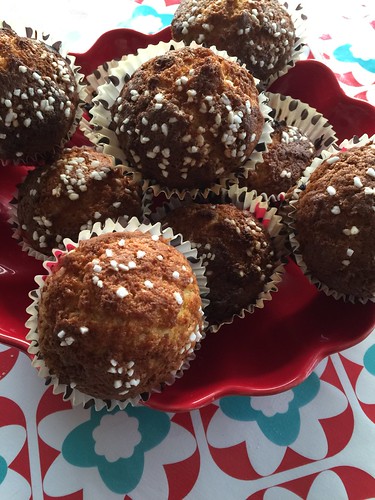
We have a new tradition. Titus goes to swimming classes every Sunday morning, and Dante gets to stay home and bake something. This Sunday, we made Lemon-Cardamom Muffins. A lovely treat, perfect for Sunday afternoon fika sessions.

Lemon Cardamom Muffins
makes 12

100 g butter, softened
190 g sugar
2 eggs
200 ml yogurt (or Swedish filmjölk)
1 tbsp lemon juice
zest of one lemon
270 g flour
1 tsp baking soda
pinch of salt
pinch of vanilla powder
1 tsp crushed cardamom seeds (Buy whole ones and crush the in a pestle and mortar - much more flavorful than ready-ground)

to decorate:
pearl sugar

Beat butter and sugar until pale and fluffy. Add the eggs, one at a time, and beat well. Add the yogurt, lemon juice and lemon zest.

In a separate bowl, mix flour, soda, salt and vanilla powder. Add the cardamom. Fold this into the wet ingredients.

Dollop into muffin cases placed in a muffin tin. Top each with a little pearl sugar. Bake at 200°C for 15-18 minutes.

Rick Bayless on Mexican Beer

Rick Bayless is a chef, restaurateur, host of Mexico: One Plate at a Time and a beer enthusiast. He knows a lot about the history of Mexico, Mexican food and drinks. Recently I was fortunate enough to attend a blogger event hosted by Negra Modelo and I had the opportunity to talk with him about  Mexican beer and food pairing and his plans for a microbrewery as well as a bit about the history of beer in Mexico.


What styles of beer complement Mexican food? 
Rick Bayless: All types of beer complement Mexican food because Mexican food is so varied! On a hot day Pacifico with ceviche is great. Negra Modelo goes well with barbacoa which I make with short ribs, slow cooked with red chile sauce. 

The reason I like Negra Modelo is because it has a little fruitiness from the hops, the natural sweetness from the barley malt even helps it to pair with richer dishes like queso fundido.

Is it true you're opening a microbrewery?
RB: I am opening a microbrewery in Chicago, it’s a think tank and it’s where we’ll create beers for our restaurants. We will also see if there is a beer that we can scale up working with Negra Modelo for larger distribution. 

What kinds of beers are you developing? 
RB: I’m not super into flavored beers. I am exploring Belgian yeast strains, I find they make food friendly beers. I like the gentle use of spices, not chiles to heat up but to cool down like green coriander for example which has citrus notes.

Why aren't beers commonly sold on tap in Mexico? 
RB: Tap beer has to be refrigerated and that wasn’t easy to do in Mexico. The distribution of bottles was much easier, but the craft beer movement is changing that in Mexico and you’ll find more taps today.

How did beer become the most popular drink in Mexico, surpassing the indigenous drink, pulque? 
RB: Pulque is made every day and it’s delicious the first day, sour the next day and it just gets more and more sour. By the fourth day it’s terrible. Unlike beer it can’t be pasteurized. Anywhere you can make mezcal, you can make pulque because it’s made from the maguey sap which is collected twice a day. The plant takes 6-10 years to produce the sap, then it produces it for 6 months and dies. It’s a very nutritious drink, low in alcohol and contains active cultures. But it is labor intensive and hard to mass produce, unlike beer. 

Pulque was associated with the poorest classes who drank it because it was nutritious. The upper classes were European and drank beer, which is not particularly nutritious, but the lower classes saw the Europeans drinking it and aspired to drink it too. Beer was more expensive but much more stable and sanitary than pulque.

Disclaimer: My thanks to Negra Modelo for sponsoring an event during which I was able to interview Rick Bayless. I was not monetarily compensated for this or any other post. 

Broccoli Crunch Recipe

They say there are no original ideas and sometimes even when I think I've come up with something new, I find a quick search on the internet proves otherwise. While I try to invent my own creative combinations, sometimes I do find my inspiration online, in cookbooks or in restaurants. Recently I was in Las Vegas where I had a couple of very inspiring meals at Carson Kitchen.

The restaurant serves rich small plates including impossibly crunchy chicken skins and meatballs in a luscious creamy foie gras sherry sauce. One of the dishes I knew I would want to try and recreate at home was their “broccoli crunch.” It turns out there are lots of versions of this dish online, although their version was certainly unique. The menu description included sunflower and pumpkin seeds as well as green goddess dressing. The salad also has dried cranberries and a handful of halved grape tomatoes. I decided to substitute tangerines in place of the tomatoes, which aren’t really in season this time of year. I like the way this dish straddles the line between salad and green vegetable. I plan on serving it at Thanksgiving.

Green goddess dressing is something I had never made before. The original recipe comes from the Palace Hotel here in San Francisco. It was named in tribute to an actor who was starring in a play called The Green Goddess. The original recipe blended green onion with mayonnaise, tarragon, parsley, vinegar and anchovies. I adapted my recipe from some updated ones I found that included sour cream and use chives instead of green onion. The creamy herbal dressing really complements the fresh crunchy broccoli, the rich crisp seeds and sweet notes from the cranberries. The tangerines provide that pop of bright acidity as well as sweetness.

Broccoli Crunch 
Serves 4- 5, easily doubled or tripled for a crowd

Salad
1 pound broccoli cut into bite-sized florets
1/3 cup dried cranberries
1/4 cup raw sunflower seeds
1/4 cup toasted pumpkin seeds
2 tangerines or mandarins, peeled and seeded 

Dressing
2 anchovies
1 1/2 teaspoons minced tarragon
2 Tablespoons minced chives
2 Tablespoons minced parsley
2 teaspoons apple cider vinegar
1/3 cup mayonnaise 
1/4 cup sour cream
1/4 teaspoon kosher salt 
Freshly ground pepper

Heat a large pot of water and when it boils add the broccoli and blanch for one minute, then drain and place in a bowl of ice water to chill. Drain and dry thoroughly. Combine the broccoli with the cranberries, sunflower seeds and pumpkin seeds. Break the tangerine into segments and cut each segment in half crosswise. Add tangerine pieces to the broccoli. 

In a bowl mash the anchovies. Add the herbs, vinegar, mayonnaise, sour cream, salt and a few grinds of pepper. Stir until well combined and taste. 

Combine the salad and dressing until thoroughly combined. Chill until ready to serve.

Enjoy!  

Lentils + Kale + Egg + Avocado Bowl


Let's face it, it's almost time to stuff ourselves to the brim with holiday feasts.  I am not opposed to that, don't get me wrong.  But before we fatten up for wintertime, how about a nice, light, healthy dinner?  This is exactly that - a meal rich in nutrients but hearty enough to fill our tummies.  Sorry I said tummies, but I have three children under six years old.  

I loved, loved, LOVED this dish.  And versatility is the best part about it.  Quinoa instead of lentils?  Sure.  Poached egg instead of fried?  Yup.  Swiss chard instead of kale?  Uh huh.  Add sausage?  Yes please!  This is getting annoying.  Everything worked so well together... and the crunch of toasted coconut on top sealed the deal.  Even if you think you don't like coconut, toast some up and try it on this dish.  I will pay you, except no I won't.       


Lentils + Kale + Egg + Avocado Bowl
(Makes 2 bowls)

2 large eggs
2 cups dried lentils
4 cups water
1 bunch kale, chopped (rough stems removed)
1 T parmesan 
1 avocado, cut into long slices
1/4 cup coconut, lightly toasted in a dry pan
Salt and pepper
Olive oil

In a medium pot, combine lentils and water and bring to a boil.  Lower the heat until only a few bubbles are left, and let simmer for 30 minutes or until lentils have absorbed water and are no longer crunchy.  Generously season with salt and pepper.  While lentils are cooking, heat a couple tablespoons of olive oil in a large pan over medium heat.  Add chopped kale and parmesan, and sauté until kale begins to wilt (I still like a bite to my kale, so I only cook it for a few minutes).  Place kale in a bowl.  In same pan, add a splash of olive oil and turn up heat to medium-high.  Crack two eggs into pan, and cook until edges start to brown.  With a spatula, gently flip eggs and turn off heat.  Assemble lentils, kale and sliced avocado into two bowls.  Add one egg per bowl, sprinkle with toasted coconut and season with salt and pepper to taste.  

Cooking Turkey for Small Gatherings


I've cooked whole turkeys when developing recipes for clients, but a Thanksgiving feast? I’m most thankful that I can spend the holiday at my parents house and let them take care of cooking the bird.

Some years I return home with leftover turkey, other years I buy a turkey at the store and ask the butcher to cut it into either halves or quarters so I am not overwhelmed with too much turkey for my household of two. 

Here are some more great ways to enjoy turkey without buying a whole bird:

William Wilkinson

Dark meat
Legs and thighs are great for lovers of dark meat. They can be roasted or braised. 


RosieTulips

Light meat 
Turkey breast is a good option for roasting, if you like light meat only.   If you are only cooking the breast, it will be much easier to cook since the breast meat tends to cook faster and become dry more quickly than other cuts. 


Dark & Light meat
This year I got a chance to try the Diestel light and dark roast. They are fully cooked, from boneless breasts, legs, and thighs with skin and are hand-netted. Size wise they are around  2 1/2 to 3 pounds (more than enough for 4 people) and cost $34.99. Each slice has both dark and light meat. The instructions recommend coating the roast with paprika but I used an herb and spice mix. These roasts are available at Whole Foods market


Disclaimer: My thanks to Whole Foods for providing a Diestel roast for me to try. 

Pomsgiving Cocktail: Drinks on Friday

pomsgiving cocktail
The last few years I've created a cocktail for Thanksgiving. It's a fun way to start the long Thanksgiving day feast. It perks the appetite and gives everyone something to talk about.  I recently attended a POM Wonderful lunch and was inspired by all the wonderful cocktails. So instead of using the more common cranberry juice, I thought it would be interesting to try using pomegranate juice.

This cocktail uses truly some of my most favorite things--limoncello, Plymouth gin and La Marca prosecco. I discovered La Marca prosecco when I was looking for the perfect prosecco to make the Ruby Sparkler last year. It's from the Veneto, tart and fresh with plenty of bubbles. It's about $10 at Costco and makes a terrific mixer. Plymouth gin is my go to gin, I find it the easiest for mixing because the botanicals are so well balanced. Use whichever limoncello you like. 

I am not a bartender and I find it tricky to come up with cocktails. Working out the proportions took some time but I'm very happy with the final result and hope you like it too! I haven't decided on a garnish yet, what do you think? Lemon peel? Pomegranate arils? Let me know in the comments. 

Pomsgiving

3/4 ounce Plymouth gin
1/4 ounce limoncello
1 ounce POM Wonderful juice or freshly squeezed pomegranate jucie
Prosecco (La Marca recommended)

Combine the gin, limoncello and pomegranate juice in a shaker with ice. Shake and strain into a glass, top with prosecco. 

Enjoy! 


Disclaimer: My thanks to both POM Wonderful and Plymouth gin for providing me with product to use in my cocktail experiments.