|
| Parmigiano Reggiano display at Eataly, NYC |
As you may recall, the idea of the global dinner party is is to pick some recipes, invite your friends over, cook, eat, and then share photos of your feast if you're so inclined. In the past there have been some very avant garde recipes made available, such as a broth made from the rind of the cheese, and
risotto cacao e pepe, but you can make whatever you like as long as it includes Parmigiano Reggiano. There's a
video about it from last year when it was celebrated at Eataly in NYC.
Parmigiano Reggiano is a cheese I fear sometimes gets taken for granted. When I was at Eataly in New York last week I saw a great selection of the cheese, including one of my favorites vacche rosse and some aged 30 months. I hope you’ll take this opportunity to celebrate it.
Sign up on the Parmesan website and you'll be notified when the free app is ready.
The gift basket is worth over $250 dollars and includes the following:
• Two wedges of Parmigiano Reggiano cheese
• Paesano Bread
• Il Mongetto Diavola Sauce
• Rustichella Spaghetti
• Zingerman's Travel Olive Oil
• Leccino Olives
• Cristal Peppers
• Crespone Salami
• Antonio Mattei Biscotti
• Espresso Blend Coffee
• Zingerman's Wooden Crate
If you would like to win this fabulous gift basket, please leave a comment telling me your favorite way to use Parmigiano Reggiano. A winner will be picked at random. A winner will be chosen on October 7, 2014. You must have a mailing address in the continental US and you must include your email in the proper field to win, it will not be published and no one will see it but me. One comment per person, please.
My love of pasta is no secret, but I’m cutting back. An
article in the New York Times covering the latest research about the benefit of low carbohydrate diets has me rethinking my noodle consumption. I won’t give them up completely but now and again I can see trying something different. Something like zucchini noodles.

For a long time I’ve wanted one of those spiralizer type tools. But they are rather expensive and I just wasn’t sure how much use I’d get out of them. There is actually an easy way to make “noodles” out of zucchini or other vegetables using a box grater. You just
lay the grater on its side like a mandoline! But I’ve just recently tried out the
Microplane spiral cutter and it’s an even better option. At $14.95 it’s a lot less expensive than some of the other tools and takes up very little space. It also has two sizes so you can shred larger or smaller vegetables.
The downside to using this gadget is that it takes some time to get used to it, and to figure out how much pressure to exert to get the thickness of noodles you like. It also leaves a little stubby core of the vegetable. But it’s relatively easy to use and clean once you get the hang of it.
I don’t like raw zucchini, but by cooking the zucchini noodles in a pan sauce, you get a lovely texture and the zucchini does seem to absorb a bit of the sauce. You can also blanch the "noodles" quickly in boiling water to take off the raw edge and then toss them with a cool sauce like pesto. I’ve only begun experimenting with zucchini noodles but I’m enjoying them so far. While not chewy, they do have a lovely slippery feel.
 Zucchini Noodles with Fresh Tomato Sauce
Makes 2 servings
2 Tablespoons olive oil
1 cup cherry tomatoes
1 clove garlic, thinly sliced
1/3 cup peeled small to medium raw shrimp, optional
Trim then
shred the zucchini using the large holes on a box grater or using a “spiralizer” tool. Heat a skillet and add the olive oil. Add the tomatoes and cook gently until they begin to break down and become saucy.
Add the zucchini and garlic and cook until the sauce reduces by about half. Add the shrimp, if desired, and cook just until the shrimp are pink and cooked through, the time will vary depending upon the size of the shrimp but probably no more than a minute or so. Season to taste with salt and pepper.
Enjoy!
Disclaimer: My thanks to Microplane for providing me with the spiral cutter to test.
On my first trip to a city I always try to experience the things that the place is famous for, especially the food. Recently I was in Toronto which is a very diverse city with all kinds of food, but the peameal bacon sandwich is one of its most iconic specialties.
Toronto was once known as Hogtown, thanks in part to the vast stockyards where in the mid to late 1800’s cured pork products like bacon were sent to the United Kingdom, where there was a shortage at the time. In 1900 over half a million pigs were processed for export in Toronto.
So what is peameal bacon exactly? It’s what we call “Canadian bacon” in the US. It’s made from pork loin, rather than belly, so it’s much leaner than typical bacon. It’s brined and cured, not smoked. It was originally rolled in ground dried yellow peas to help preserve it, but cornmeal became much more widely available in the 1900’s and also preserved the meat better.
Peameal bacon, also sometimes called back bacon, is juicy and salty but not nearly as salty as streaky bacon. It’s served sliced and makes a very fine sandwich.
One place to try the famous peameal bacon sandwich is at the
St. Lawrence Market. You can see peameal bacon in the cases of butcher shops and there are at least two places that serve the sandwich,
Paddington’s Pump, a full service sit down restaurant and
Carousel Bakery, a market stall. The Paddington’s Pump sandwich features thinly sliced peameal bacon and comes on a crusty roll with tomato and lettuce and some slaw and pickle on the side. At Carousel Bakery the sandwich is served on a hamburger bun with thick cut peameal bacon. You can also get the “breakfast on a bun” with peameal bacon, a fried egg and cheese.
After you try the peameal bacon sandwich, I recommend trying the eggs benedict at the classic diner,
The Senator which is Toronto’s oldest restaurant. It’s two poached eggs on peameal bacon with hollandaise sauce on a homemade biscuit. Both are so good that I'm not sure which I prefer!
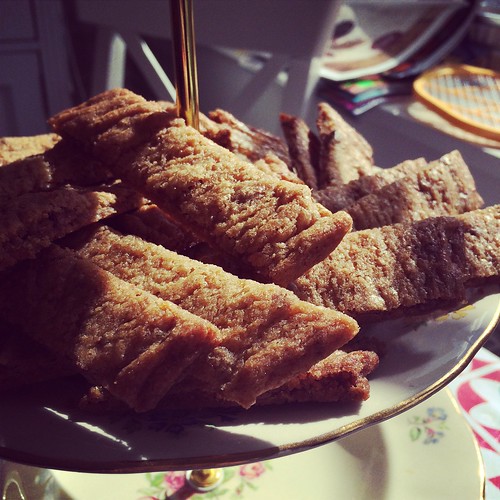
This type of cookies is called "snitt" in Swedish - translates into "cuts" which is exactly the method for making these. Just like Italian cantuccini, you shape long logs of dough, bake and slice. These are not re-baked like biscotti though, instead they're left to cool and that leaves them crispy on the edges with a soft, chewy middle. These particular cookies are full of milk chocolate and lemon zest. Truly amazing.
Milk Chocolate Lemon Cookies
makes 40 or so
150 g butter, softened
140 g caster sugar
140 g brown sugar
1 egg
2 tsp vanilla sugar (or 1 tsp extract)
1/2 tsp baking soda
pinch of salt
240 g all-purpose flour
100 g milk chocolate, coarsely chopped
zest from 1 lemon
Start by creaming the butter and both types of sugar very, very well. (My butter was, as usual, not softened, so I just creamed it for much longer.) Add the egg and vanilla and beat until mixed. Add the dry ingredients - baking soda, salt and flour - and mix until combined. Finally add the chocolate and the lemon zest.
Shape into four slender logs and place on lined baking sheets. Bake at 175°C for 10-12 minutes. Remove from the oven and leave to cool for a minute before cutting them, diagonally, into cookies. Leave to cool completely.
These freeze very well but lose some of their chewiness.
It’s back to school and that means bag lunches. Or maybe like me, you don’t have school age kids, but still want to start packing lunch to take to work. It’s easy to get in a rut, but these three cookbooks offer many ways to jazz up your lunchbox.
The
Banh Mi Handbook is the latest book from Andrea Nguyen. In the past she has written about Vietnamese food, dumplings and tofu, perhaps convincing you to make your own. But I had to wonder, when I can get a terrific banh mi sandwich for just a couple bucks, would I want to make my own? The answer is YES because Nguyen goes well beyond what you might find at a Vietnamese sandwich shop.
What I absolutely love the most about this book in addition to the versatility is the focus on ease and simplicity. There are lots of shortcuts and no shame if you choose to buy bread or mayonnaise or doctor some liverwurst to make a tasty pate. The book offers the basics and traditional recipes for fixings like carrot and daikon pickles, headcheese terrine and Chinese barbecue pork but also offers tons of non-traditional options too to keep things interesting. Go vegetarian with coconut curry tofu or an edamame pate. I know I’ll be making the warm sardine and tomato sauce sandwich and the oven fried chicken katsu. These are sandwiches that will make your mouth water!
 Mason Jar Salads, a slim volume of lunch and breakfast worthy recipes includes why-didn’t-I think-of-that ideas that are perfect for when you want to bring something delicious from home. The book includes smoothies, soups, dips and more. But salads are the main event and author Julia Mirabella comes up with very creative layered ones like spinach, blueberry and blue cheese, or barley and zucchini salad and even a layered cobb salad. Dressing layered on the bottom of the jar keeps everything from getting soggy and makes shaking the new tossing. So smart! This book will give your lunch a jolt.
 A traditional Japanese lunch is bento, or box lunch. As someone who loves variety, I go crazy for bento boxes, especially the ones they sell at railway stations in Japan. They often contain 5 or 6 small nibbles like flavored rice balls, pickles, salads and all kinds of meats and vegetables. They might look complicated but they don’t have to be. That’s the message behind Effortless Bento. This book shows you how to make ahead over 300 items so you can create a tasty and exciting lunch in no time. The full color pictures really help to show how a few items come together to make a meal. There are single dish bentos too like dry curry bento.
As long as you have access to a refrigerator, you can make all kinds of delectable vegetable and meat dishes, many can even be frozen ahead of time. The one caveat about this book is that the recipes are Asian, though not all Japanese, some do require a trip to an Asian market for specialty ingredients like burdock, dried shrimp or lotus root. But plenty of recipes use only 3-5 very basic ingredients.
Disclaimer: These books were provided as review copies and this post includes affiliate links.
I just got Veckans Favoriter ("Weekly Favorites") by Sara Begnér in the mail. I have to say, she is one of my favorite Swedish cookbook authors. Her recipes are easy to make, approachable, no weird ingredients that you can't find at the store, pretty healthy but still fun, playful and very flavorful. This book focuses, as the name implies, on weeknight dinners. Lots and lots of them! I'm seriously stuck in a rut, which is also why I have nothing to blog about, so I'm definitely eager to try some new things.
.png)
 I’m very excited to be offering a fantastic giveaway basket courtesy of Zingerman's and Parmesan.com